Speed Runner: Hyper Electric
- 4.5
- Rating
- 1.00M
- Installs
- Free
- Price
 Analysis by App-foxy
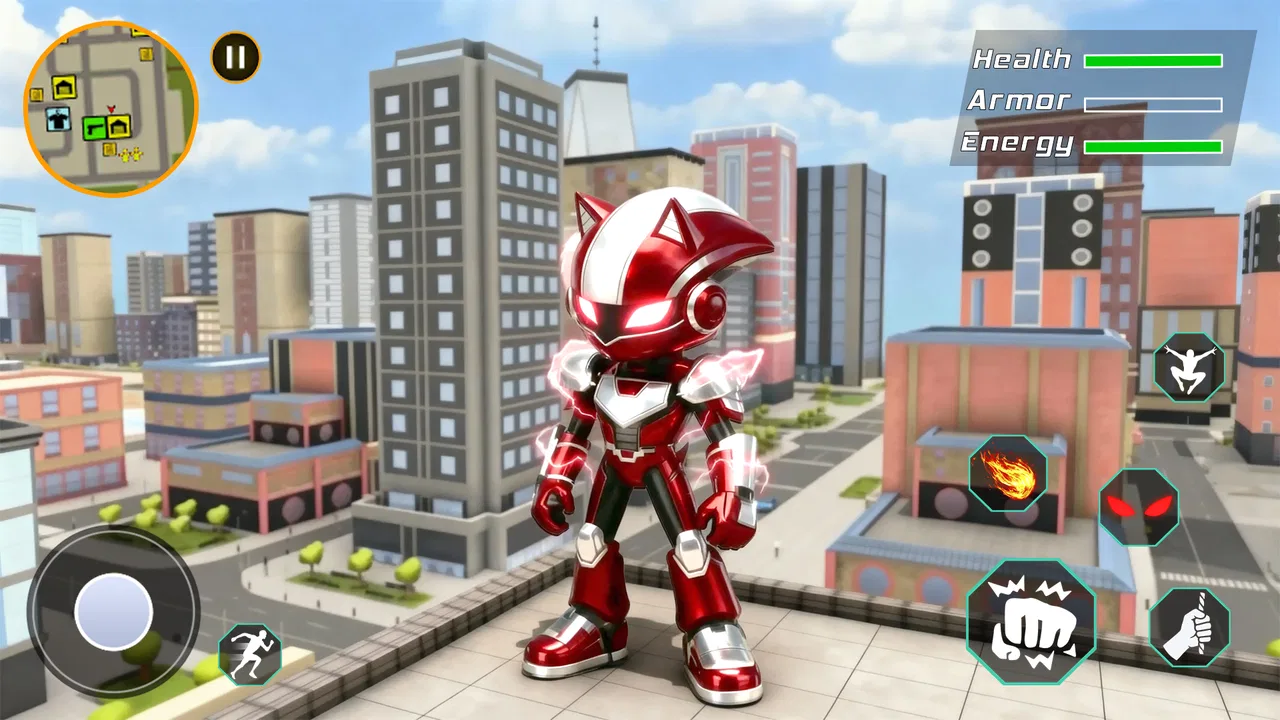
I went into Speed Runner: Hyper Electric expecting a quick action game built around movement, and that is exactly where its appeal begins. It puts the emphasis on speed, sudden direction changes, airborne momentum, and the kind of ragdoll chaos that makes a short session easy to start. The setting is a crime-filled city, but the real attraction is not a deep crime story; it is the sensation of being a highly mobile hero trying to stay in control while everything around the character feels unstable.
That distinction matters. This is not the sort of game I would choose when I want a large role-playing adventure, a carefully written campaign, or a slow tactical challenge. I would choose it when I have a few spare minutes and want immediate action without a long setup. It is a free action game from Tuan Anh Hoang, aimed at Everyone, and its simple premise makes it approachable even if you do not usually spend much time with mobile action titles.
Why the first sessions are so easy to enjoy
The first-week appeal comes from how quickly the game communicates its basic pleasure. Running fast is satisfying on its own, but dashing adds a sharper rhythm: move, react, commit, and recover when the character goes off balance. The ragdoll element gives mistakes a physical, sometimes funny consequence rather than making every failure feel like a formal punishment. I found that combination more inviting than a rigid action game that expects perfect timing from the first minute.
You May Also Like

 Blood Strike: 2.5 Anniversary
Blood Strike’s Loadouts Turn Every Drop Into a Tactical Gamble
A close look at Blood Strike’s custom loadouts: how fast access to signature weapons reshapes its battle royale rhythm, rewards preparation, and narrows the gap between fights.

 Pandora - Music & Podcasts
Pandora’s Music Is Easy to Start, but Harder to Recover
Pandora’s strength is its low-effort path from a seed to a station. Its weak spot is how much confidence it asks you to place in connection, setup, and quiet recovery.

 8 Ball Pool
 Is Built on Rivalries, Rematches, and Routine
A close look at the rivalries, rematches, shared routines, and unanswered safety questions that turn a quick pool match into a persistent mobile community.

 Samsung Music
’s Quiet Strength Is Playing What You Already Own
Its reach comes less from spectacle than from dependable access to a personal library. That simplicity is both the app’s strongest retention engine and its ceiling.

 AccuWeather: Weather Radar
AccuWeather Review: A Quick, Clear Forecast for Everyday Decisions
For everyday plans, the best forecast is the one you can understand quickly. AccuWeather makes rain timing, radar, and local conditions easy to act on, with a few trade-offs.

 Hill Climb Racing
Why Hill Climb Racing Still Turns Crashes Into One More Run
A tiny car, a bumpy hill and one more upgrade: Hill Climb Racing keeps resurfacing because its simple chaos makes every near-miss feel personal.
More From Our News Desk
View All News


The city backdrop also helps the game establish a clear mood without asking me to learn a complicated world. The action feels like a chase through a dangerous urban playground, with the player’s attention fixed on movement and survival. That directness is useful on a phone because I can understand what I am supposed to do almost immediately. There is little friction between opening the game and getting into the action.
One of the most useful ways to approach it is as a “short burst” game rather than a title that demands a long sitting. I can play while waiting for an appointment, take a few attempts during a break, or use it as a quick change of pace after a slower game. The movement-focused design supports that habit because the fun is concentrated in the moment-to-moment control rather than in lengthy preparation.
Its store short description calls it Speed Runner, but I think the more revealing part of the experience is the contrast between speed and loss of control. A clean dash feels rewarding because the character moves with purpose; a poor decision can turn into an awkward tumble. That tension gives the early sessions personality. I am not simply holding a direction and watching a character travel. I am constantly deciding whether to push forward or protect the run from my own impatience.
The game is also a good fit for players who enjoy watching physics create unexpected outcomes. Ragdoll behavior can make a failed attempt amusing rather than irritating, especially when the mistake is caused by taking a risky shortcut or mistiming a movement. I would not call that a replacement for carefully designed combat, but it does give the action a loose, playful quality that separates it from more conventional runners.
Practical advice for learning the movement
My first useful tip is to avoid treating every dash as an emergency button. Early on, it is tempting to use speed whenever the path opens, but saving a movement option for the next change in direction often produces a smoother run. The game becomes less about reacting to the current obstacle and more about reading what is likely to happen immediately afterward.
I also recommend using the opening sessions to learn recovery rather than chasing flawless movement. The ragdoll behavior means that not every mistake ends the same way. Sometimes the best response is to regain control instead of forcing another dash while the character is already unstable. That small change in mindset makes the action feel less random and gives the player more ownership over a messy situation.
A third insight is that speed is not always the same as progress. A fast move that leaves the character badly positioned can be worse than a cautious adjustment. This is especially important for people who normally play endless runners by holding a lane and reacting at the last possible moment. Here, the fun comes from managing momentum, so I get better results when I think one movement ahead rather than only looking at the immediate threat.
Who will enjoy the novelty most
I would recommend the game to someone who likes arcade action, exaggerated movement, and quick attempts that can end with a laugh. It is particularly suitable for players who enjoy experimenting with movement instead of memorizing a fixed sequence. Younger players can understand the basic idea easily, while experienced mobile gamers may appreciate the challenge of turning chaotic movement into something repeatable.
It is less suitable for anyone looking for a substantial narrative or a highly structured progression system. If your favorite action games are built around collecting equipment, developing a character, or exploring a large map with many distinct activities, this will probably feel thin. Its strongest idea is movement in a crime-city setting, and the experience is at its best when that idea is enough to keep you interested.
What remains after the opening excitement
The harder question is whether the game earns a regular place on my phone after the novelty of fast movement and ragdoll accidents fades. In my experience, the answer depends on what I want from a recurring mobile game. If I enjoy improving small pieces of execution, the loop can remain appealing because every attempt gives me another chance to handle a dash more cleanly or recover from a bad landing. If I need a steady stream of new content to maintain interest, the experience is more difficult to sustain.
The game’s long-term value comes from replaying the movement challenge, not from pretending it is a broad action package. That makes it a useful companion title rather than a complete replacement for a larger game. I can imagine keeping it installed alongside a strategy game or a story-driven adventure, opening it when I want physical immediacy instead of planning and dialogue.
For a month-to-month habit, I would set a simple personal goal: improve consistency rather than merely play longer. For example, I might focus on completing a sequence with fewer uncontrolled tumbles, learning when to conserve a dash, or finding a safer response to a familiar obstacle pattern. These goals are modest, but they make short sessions feel purposeful. Without that kind of self-directed target, the loop can become repetitive sooner.
The game’s audience size suggests that it has already attracted substantial attention, with over one million installs and an average rating of 4.4 from around one thousand three hundred ratings. Those figures do not guarantee that it will suit every player, but they do fit my impression that the central idea is immediately understandable. The broader appeal is easy to see: fast action, a playful physical style, and no purchase price required to try it.
The current version is 1.0.7, and the game was released on December 26, 2025. I mention those details because they frame my expectations about longevity. A relatively early version can be enjoyable right away, but I would not judge its long-term place in a library solely by the first burst of attention. The real test is whether the core movement remains satisfying when I am no longer discovering it for the first time.
A realistic everyday routine
Imagine having ten minutes before leaving home. I would open the game, play a few attempts, and stop after one run that feels clean rather than continuing until frustration takes over. That is a better fit than starting a long campaign that I cannot finish. On another day, I might play during a commute, provided I have enough attention for quick reactions. The main benefit is that the game can fill small gaps without requiring me to remember a complicated plot or rebuild a setup each time.
There is also a useful “reset after work” scenario. After a tiring day, I may not want a demanding puzzle or a competitive match where every mistake feels serious. A short session of dashing through a city and watching a failed move turn into ragdoll chaos can provide a lighter kind of engagement. The trade-off is that the same looseness may feel unsatisfying when I am specifically looking for precision or a strong sense of achievement.
Maintenance is light, but attention still costs something
From a practical standpoint, the game is easy to keep available because it is free and supports devices running Android 7.0 or later. The Everyone age rating also makes it a straightforward recommendation for a broad household audience. I do not need to reserve it for a particular mood or a specialized gaming setup; its basic format is accessible enough for casual use.
The maintenance burden is therefore less about managing the app and more about managing my own expectations. I need to remember what kind of experience it offers. If I open it expecting a new campaign, a deep combat system, or a large collection of long-term objectives, I will likely judge it unfairly. If I open it for compact movement-focused action, it makes much more sense.
Another maintenance issue is habit. Because the sessions are easy to start, it can become tempting to repeat attempts without a clear reason. I get more value when I decide what I am practicing before I begin. That might be controlling momentum, avoiding unnecessary dashes, or learning to recover instead of panicking. A small intention turns repetition into practice; without one, repetition can become background tapping.
I would also keep the game as part of a rotation rather than making it my only mobile action title. Alternating it with a game that offers exploration, combat variety, or a stronger progression system prevents its central mechanic from becoming overfamiliar. This is not a criticism of its simplicity. It is simply the natural cost of a game built around one highly visible idea.
Where fatigue begins
The main source of fatigue is repetition in the core movement loop. Speed, dashing, and ragdoll reactions are enjoyable, but they can lose impact if I am not discovering a new personal challenge. The setting gives the action a recognizable identity, yet the city alone cannot carry every session. Once the novelty of seeing the character move at high speed has passed, the quality of my continued experience depends heavily on whether I still enjoy refining control.
Another possible frustration is the boundary between skill and unpredictability. Ragdoll behavior is entertaining when I understand why I lost control, but less satisfying when a run feels messy without a clear lesson. I find the game works best when I accept that some chaos is part of the design while still looking for the decision that caused it. Players who want every failure to provide precise feedback may prefer a more disciplined action game.
The game can also feel limited for people who need a strong sense of destination. A runner built around immediate movement is naturally more abstract than an adventure with missions and character development. If I want to feel that I am building toward a major payoff, this may not provide enough structure. Its reward is the quality of the attempt itself, which is a valid design choice but not one that suits everyone.
Controls are another area where patience matters. Fast movement leaves less room for hesitant inputs, and the transition from a successful dash to an uncontrolled tumble can make early attempts feel rough. My advice is to judge the game after spending time learning its rhythm, not after one awkward session. At the same time, I would not force myself to adapt indefinitely: if the movement never feels readable, a conventional runner or more deliberate action game is probably a better use of my time.
How it compares with familiar alternatives
Compared with a traditional endless runner, this game places more emphasis on physical momentum and recovery. A conventional runner often rewards lane changes and predictable timing, while this experience is more expressive and less tidy. That makes it more entertaining for players who like improvisation, but less appealing to those who prefer a clean, repeatable pattern.
Compared with a larger open-world crime game, it offers a much narrower slice of the fantasy. I get the atmosphere of a dangerous city and the feeling of being an unusually capable hero, but I am not choosing between many jobs, vehicles, weapons, or story paths. The advantage is immediacy: I can reach the central action quickly. The disadvantage is that there is less variety when I want a richer simulation.
Compared with a precision platformer, it is more forgiving in spirit but also less controlled in presentation. The ragdoll element adds humor and surprise, whereas a precision title usually makes exact execution the entire point. I would choose this game for playful momentum and a casual challenge; I would choose the platformer when I want every movement to feel deliberate and measurable.
Who should install it, and who should skip it
I think it earns a place on a phone for players who want free, accessible action that works well in short sessions. It is a good choice if you enjoy experimenting with movement, do not mind occasional physical chaos, and can create your own improvement goals. It is also a sensible first action game for someone who wants an uncomplicated premise rather than a large commitment.
I would skip it if my priority were deep progression, a substantial narrative, competitive ranking, or a broad set of activities. I would also look elsewhere if I dislike games where a failed movement can become funny but somewhat untidy. A more structured runner would be better for predictable repetition, while a full action adventure would be better for story and variety.
For me, the deciding question is simple: do I still enjoy making one movement cleaner than the last? If yes, the game has recurring value. If I am only opening it because the first few ragdoll moments were amusing, the appeal may fade quickly. That is not a flaw so much as an honest description of its narrow but clear purpose.
Overall, I see this as a compact action game with a strong first impression and a more conditional long-term future. Its free entry, broad age rating, low learning barrier, and energetic movement make it easy to recommend for quick sessions. The lasting value depends on whether the player enjoys self-imposed mastery and can accept a loop centered on movement rather than constant expansion.
My final recommendation is to try it as a focused arcade companion, not as your main long-term adventure. The game earns its space when I want a fast reset, a few risky dashes, and the occasional ridiculous tumble. After the novelty fades, it remains worthwhile for players who enjoy refining control and keeping a lightweight action habit. For everyone else, it is likely to be a fun temporary install rather than a permanent fixture.
FAQs for Speed Runner: Hyper Electric
01What is Speed Runner: Hyper Electric?
Speed Runner: Hyper Electric is an adrenaline-pumping mobile game available for both Android and iOS platforms. In this game, players navigate through electrifying levels filled with obstacles and challenges. The objective is to achieve the fastest time possible while collecting power-ups and avoiding hazards. It's a game designed for those who love speed and excitement.
02Is Speed Runner: Hyper Electric free to play?
Yes, Speed Runner: Hyper Electric is free to download and play. However, the game offers in-app purchases that can enhance your gaming experience. These purchases may include special power-ups, additional levels, or cosmetic items. Players can enjoy most of the game without spending money, but premium content is available for those who wish to expand their gameplay.
03What are the system requirements for Speed Runner: Hyper Electric?
To run Speed Runner: Hyper Electric smoothly, your device needs to meet certain requirements. For Android, a version 6.0 or higher is recommended, with at least 2GB of RAM. iOS users should have iOS 11 or later. Ensure you have enough storage space, as the game frequently updates to include new features and levels.
04Can I play Speed Runner: Hyper Electric offline?
Speed Runner: Hyper Electric primarily requires an internet connection to access all features, especially for leaderboards and multiplayer modes. However, a limited offline mode is available, allowing players to enjoy certain levels and practice their speed-running skills without an internet connection. For the full experience, playing online is recommended.
05Are there any multiplayer features in Speed Runner: Hyper Electric?
Yes, Speed Runner: Hyper Electric includes exciting multiplayer features. Players can compete in real-time races against friends or other players worldwide. The game also offers global leaderboards, where you can compare your fastest times with others, adding a competitive edge to the gameplay. These features require an active internet connection.
Pros
- Fast-paced gameplay keeps you engaged.
- Stunning graphics with vibrant colors.
- Intuitive controls for easy navigation.
- Variety of levels to maintain interest.
- Regular updates with new challenges.
Cons
- In-app purchases can be pricey.
- Requires constant internet connection.
- Ads can interrupt gameplay.
- Battery drain is noticeable on older devices.
- Limited customization options for avatars.

Speed Runner: Hyper Electric
Gallery